
Historic Covers
A "War" Cover from China to India
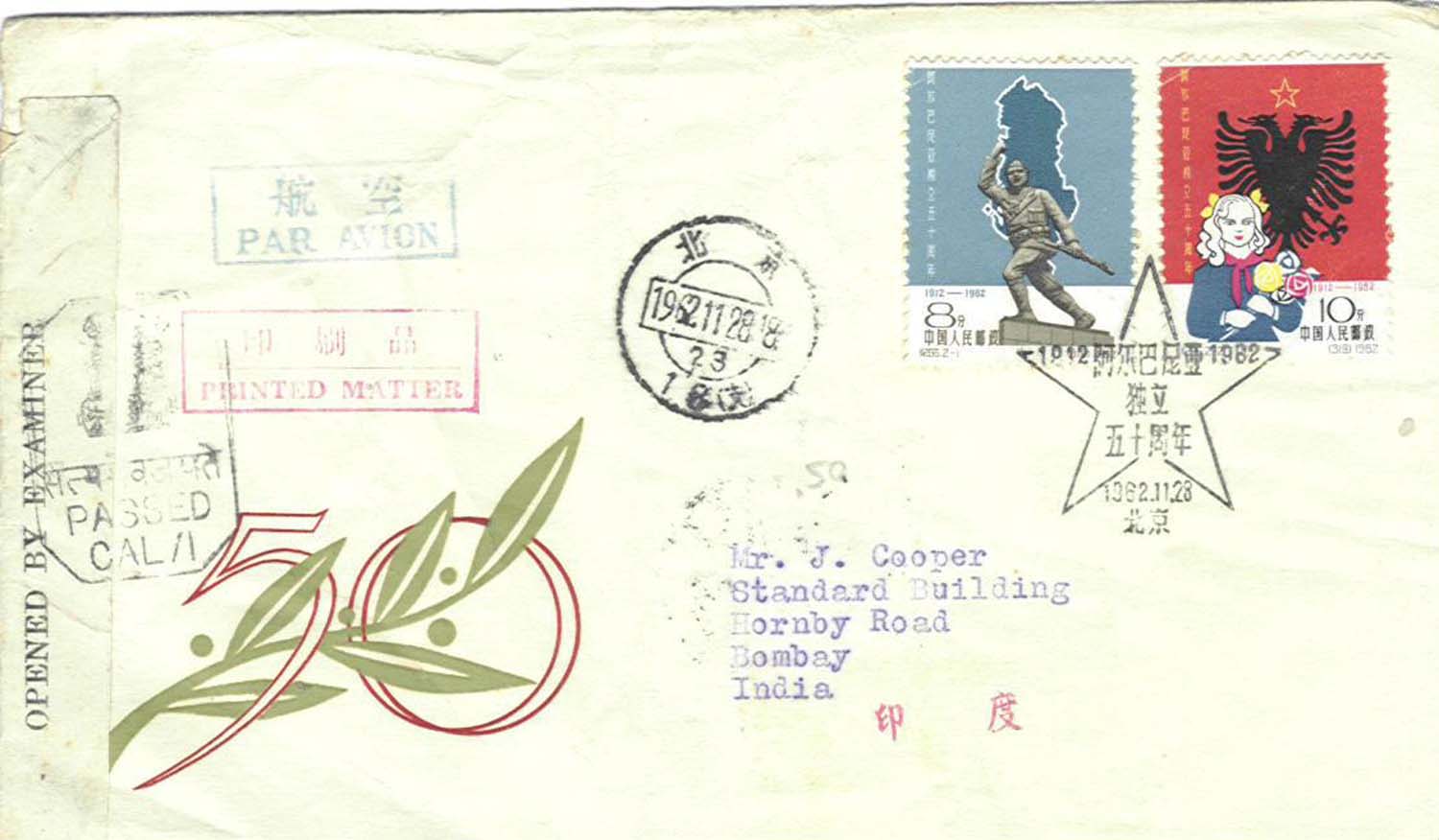 This cover bearing 50th Albanian Anniversary stamps on a First Day Cover dated 28th November 1962 attracted the interest of the Indian censors. The reason for this has nothing to do with the Albanian anniversary!
China was to all intents and purposes at war with India. No declaration of war had been made but highly trained mountain troops of the Chinese army attacked India in force and swept through their border troops,
mostly conscripts, within a month.
This cover bearing 50th Albanian Anniversary stamps on a First Day Cover dated 28th November 1962 attracted the interest of the Indian censors. The reason for this has nothing to do with the Albanian anniversary!
China was to all intents and purposes at war with India. No declaration of war had been made but highly trained mountain troops of the Chinese army attacked India in force and swept through their border troops,
mostly conscripts, within a month.
China had defined a border with Nepal and in a give and take settlement had formed boundaries with Burma. But India was different. The border with Tibet had been undefined except for the British Raj claims prior
to the Great War and the Mahon-Line which were not accepted by the Chinese! India now claimed vast tracts of land and disputed China's right to build a new highway which linked southern Tibet with Chinese Turkestan on their land.
The remoteness of the territory is demonstrated by the fact that the Chinese had actually built the Tibetan highway two whole years before the Indian authorities discovered it! It is understood that the Indian Ambassador noticed a new
Chinese map delivered to his office was showing the area as Chinese and reported the matter.
Negotiations were getting nowhere and in October 1962 the Chinese launched what they called a "counter-attack" against Indian forces which were advancing into the disputed territory and establishing outposts very close to the flanks for Chinese military positions. India claimed they were restoring the correct international boundary in Ladakh. In a month the Chinese cleared India"s forces from more than 35,000 square miles of frontier territory . At the end of November the Chinese announced a unilateral cease-fire and withdrew Chinese soldiers to the 1959 positions held by Chinese forces. It was during this period that mail from China to India was subject to examination.
Express Cover to Japan – Postal History
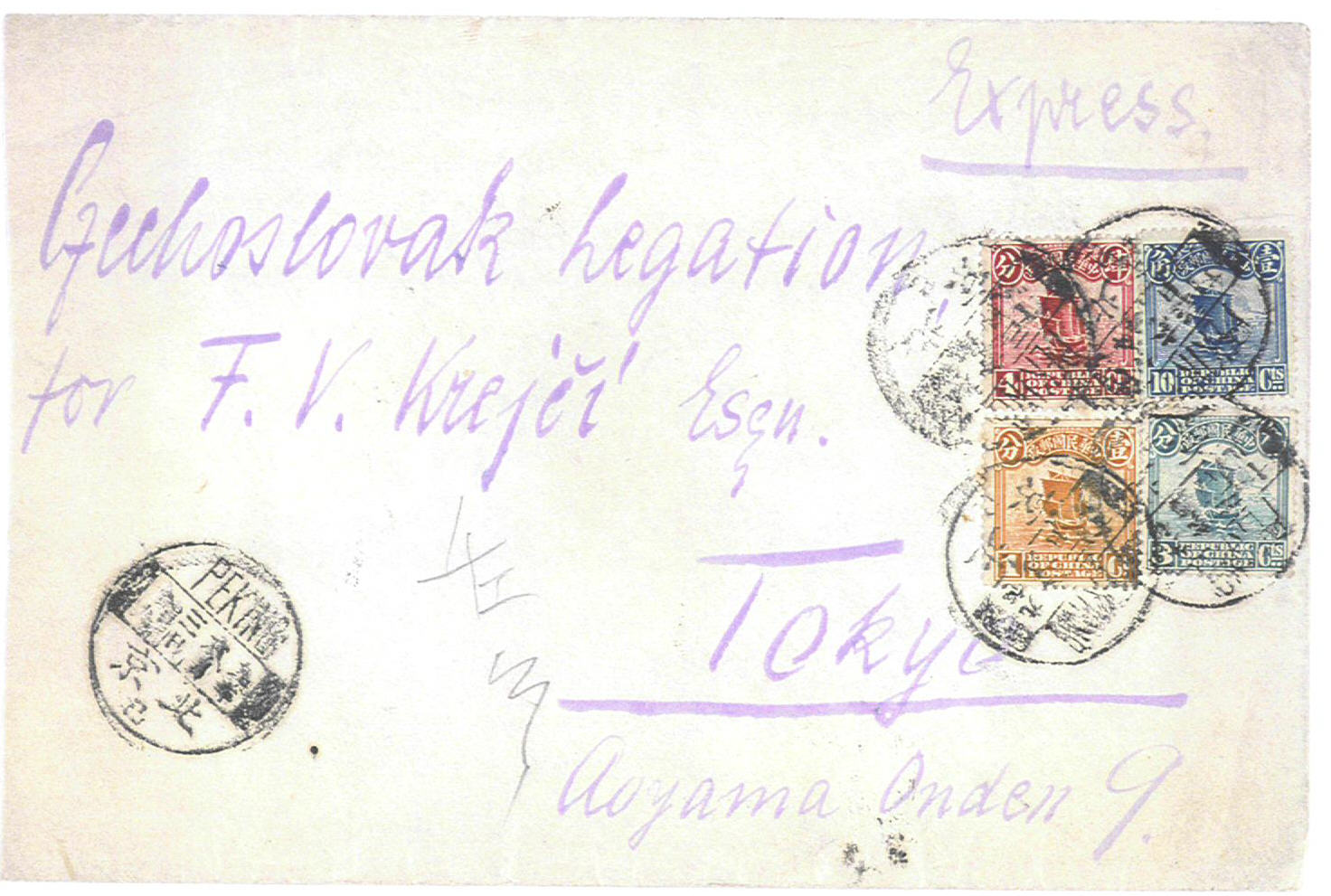 An interesting and unusual cover, pictured above, originated from Peking in 1920 and was addressed to the Czechoslovak Legation in Tokyo.
A special reduced rate for letters to Japan existed between the 5th August 1910 and 31st December 1922, and this was 3 cents per 15 gm.
On the other hand there was an "Ordinary Express" service available only after the inclusion on the international tariff as from September 1914, following membership of the UPU. being obtained.
This cover was accepted at this express rate of 12 cents. With the franking on this cover totalling 18 cent. one has to assume that it exceeded the basic weight of 15gm.
It is interesting to note that from 1st January 1923 the" Ordinary Express" fee was removed from the tariff for Japan/Korea due to the "Registered Express" fee being reduced to 10 cents. Eventually on the
9th December 1935 the "Ordinary Express" fee was re-introduced at 5 cents.
Reference: Postage Rates of China 1867-1980 Pingwen Sieh and J. Lewis-Blackburn.
Derek R. Page
Tibet Mobile Post 1956 – Postal History
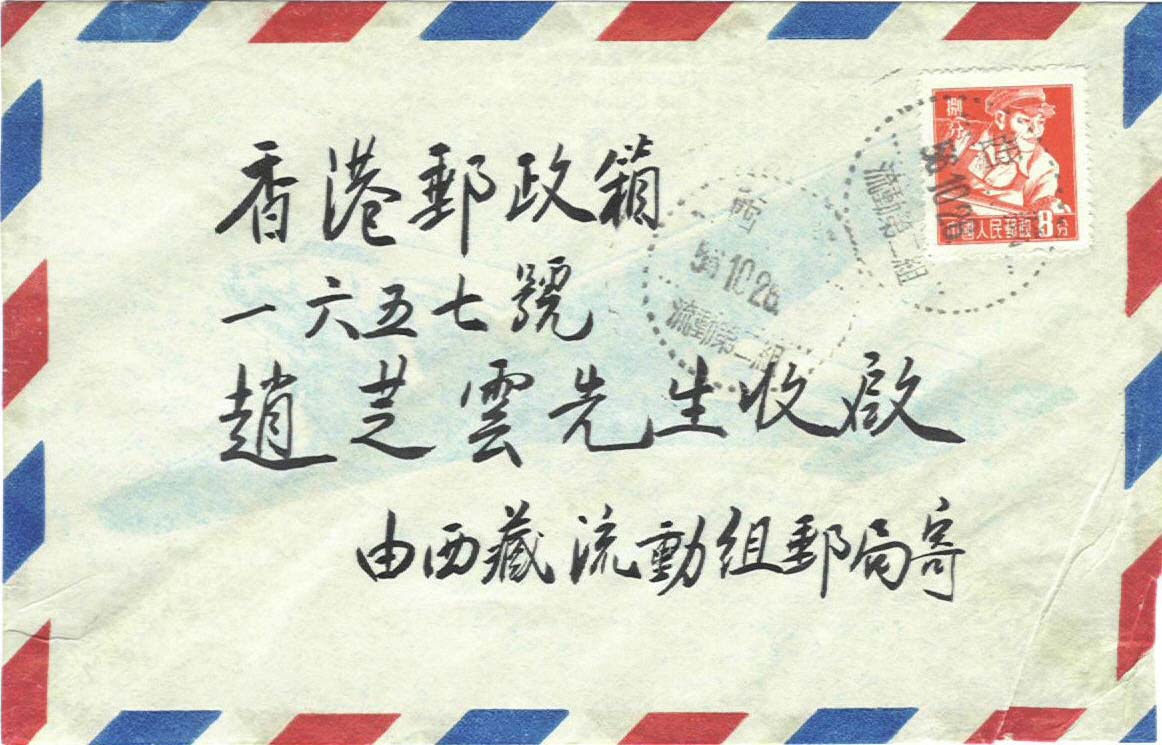 Very little is known about the MOBILE POST introduced by the Chinese communist government in Tibet in 1956. One of the first acts of the Chinese occupying forces was to
build and extend roads which made the introduction of a Mobile Post practical.
However, resistance from Tibetan guerrillas against communist rule led to attacks on the Sikang-Tibet road which on occasion was made impassable. In 1956, communist forces and guerillas
met "face to face" at Hei-Ho (Hegchu) and the Tsinghai-Tibet road was also blocked in the fighting. It spread to Chamdo and was serious enough for the Chinese to close small post offices in the less populated areas.
All this led to the abandonment of the Mobile Post. A letter from Lhasa G.PO. on March 11, 1957 reported that the Mobile Post was closed. (See Chiu Page 162 Volume 5).
Chiu wrote (page 128 Vol.5). "There are usually postal staff in the lorry to manage the postal articles, which include military family letters and ordinary business letters,
all treated in the same way. There is no definite arrival and leaving time schedule nor destinations for those lorries. They are, however, divided into series depending on which part of the road they are running."
The only postmarks seen have two characters at the top "Tibet" and the date 56.10.26 in the centre with Chinese characters underneath for "Mobile 2nd series". As no receiving marks
to go with them, it is possible the covers so far found were raided from the Mobile Post Office in transit. The "2nd series" pre-suppose that other series exist — but so far they have not been recorded.
Very little is known about the MOBILE POST introduced by the Chinese communist government in Tibet in 1956. One of the first acts of the Chinese occupying forces was to
build and extend roads which made the introduction of a Mobile Post practical.
However, resistance from Tibetan guerrillas against communist rule led to attacks on the Sikang-Tibet road which on occasion was made impassable. In 1956, communist forces and guerillas
met "face to face" at Hei-Ho (Hegchu) and the Tsinghai-Tibet road was also blocked in the fighting. It spread to Chamdo and was serious enough for the Chinese to close small post offices in the less populated areas.
All this led to the abandonment of the Mobile Post. A letter from Lhasa G.PO. on March 11, 1957 reported that the Mobile Post was closed. (See Chiu Page 162 Volume 5).
Chiu wrote (page 128 Vol.5). "There are usually postal staff in the lorry to manage the postal articles, which include military family letters and ordinary business letters,
all treated in the same way. There is no definite arrival and leaving time schedule nor destinations for those lorries. They are, however, divided into series depending on which part of the road they are running."
The only postmarks seen have two characters at the top "Tibet" and the date 56.10.26 in the centre with Chinese characters underneath for "Mobile 2nd series". As no receiving marks
to go with them, it is possible the covers so far found were raided from the Mobile Post Office in transit. The "2nd series" pre-suppose that other series exist — but so far they have not been recorded.